
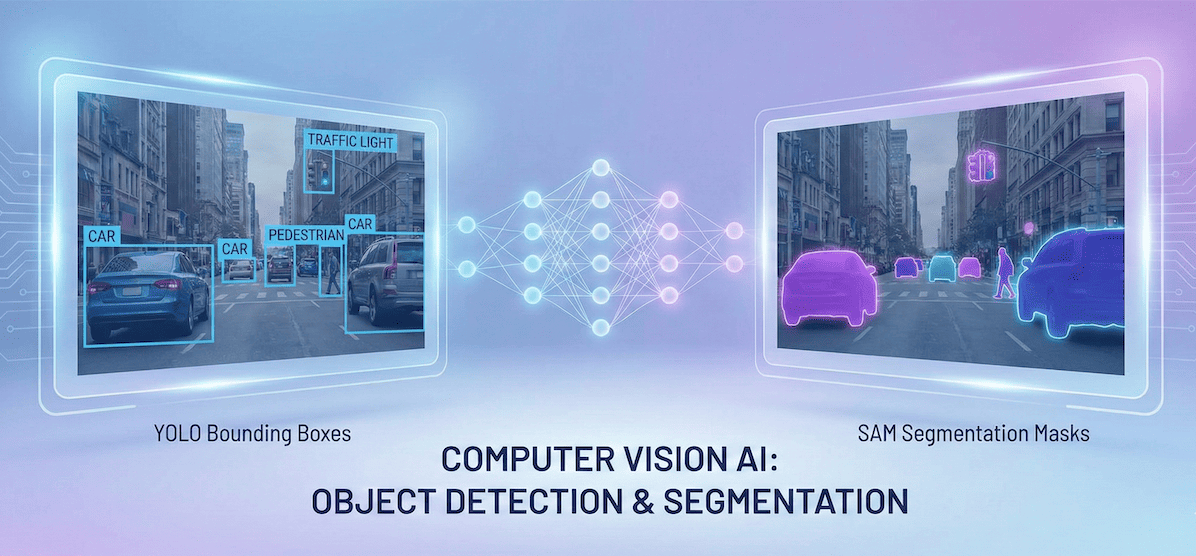
Computer vision has grown rapidly, and two new models “YOLOE” and “SAM 3” are getting attention because they help computers “see” the world. But they work very differently. This article explains both models in simple, everyday language so that students, beginners, and professionals can clearly understand what each model does and when to choose one.
Table of Contents
- What Is YOLOE?
- What Is SAM 3?
- How YOLOE and SAM 3 Work
- Key Differences Between YOLOE and SAM 3
- Which Model Should You Use?
1. What Is YOLOE?
YOLOE is a real-time “see anything” model designed for fast detection. “Detection” means finding objects in an image or a video and drawing boxes around them. It is based on the idea used in YOLO models (“You Only Look Once”), known for speed and accuracy.
YOLOE goes a step further by being more flexible; rather than detecting only predefined classes like “car,” “person,” or “dog,” it is designed to understand a wide variety of objects using text prompts or open vocabulary input. That means you can ask it to find something even if it was never trained on that specific label.
In plain words:
YOLOE is like a super-fast camera that can point out things you ask for even unusual things while the video is running.
2. What Is SAM 3?
SAM 3 (Segment Anything Model 3) is a model built for segmentation. Segmentation means dividing an image into precise shapes rather than just drawing boxes. It outlines the exact boundary of objects, which is useful for tasks that need pixel-level accuracy.
SAM 3 improves on earlier SAM versions by handling multiple segmentation styles (interactive segmentation, automatic segmentation, and region proposals) with better quality and speed compared to older models.
In plain words:
SAM 3 is like a digital scissors tool that can cut out objects precisely from an image even if you only point to them or roughly mark them.
3. How YOLOE and SAM 3 Work
YOLOE: “Spot the object”
YOLOE scans an image quickly and tells you what objects are present and where they are, usually using bounding boxes.
- It is built for speed.
- Works well in real-time video.
- Good for object tracking, monitoring, and recognition.
Think of YOLOE like a security guard who instantly points to everything happening in a room.
SAM 3: “Precisely outline the object”
SAM 3 does not focus on identifying objects first; it focuses on drawing the perfect outline of objects.
- It works even when you don’t know the object’s name.
- Can segment with one click, a text prompt, or automatically.
- Very useful when exact shapes matter.
Think of SAM 3 like an artist who draws the exact boundary of every object in a photo.
4. Key Differences Between YOLOE and SAM 3
| Feature | YOLOE | SAM 3 |
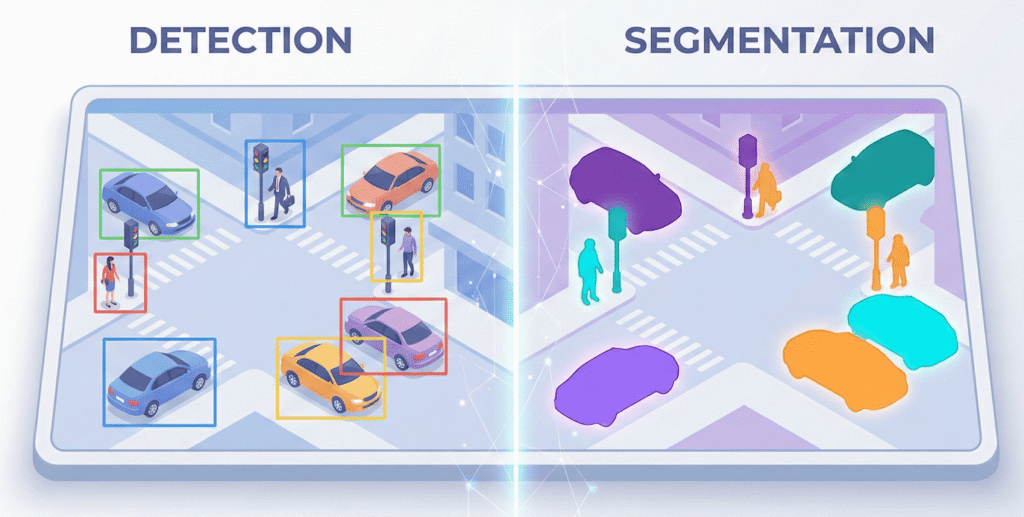
| Primary Task | Detect objects (bounding boxes) | Segment objects (pixel-level outlines) |
| Speed | Extremely fast, real-time | Slower than detection but optimized |
| Output Type | Boxes + labels | Exact shapes/masks |
| Input Style | Image or video | Image (optional interactions) |
| Ideal For | Tracking, monitoring, counting | Editing, medical imaging, labeling |
| Open Vocabulary Support | Yes | Yes (text-based segmentation) |
| Best Environment | Live video, surveillance, robotics | High-precision offline workflows |
In short:
YOLOE = Find things fast.
SAM 3 = Outline things accurately.
5. Which Model Should You Use?
✔ Choose YOLOE when you need speed
YOLOE is perfect when the system must react instantly.
Best for:
- CCTV surveillance
- Self-driving applications
- Retail store analytics
- Live sports analysis
- Real-time robotics
- Counting objects in video streams
Example:
A retail store wants to count how many customers enter every hour. YOLOE can detect people instantly from a camera feed.
✔ Choose SAM 3 when accuracy and shapes matter
SAM 3 shines when the exact outline of an object is required.
Best for:
- Medical image segmentation (MRI, CT scans)
- Product photography (cutting out backgrounds)
- Industrial defect detection
- Research and scientific image processing
- Annotation and dataset labeling
- Image editing workflows
Example:
A doctor analyzing tumors in MRI scans needs the exact boundary. SAM 3 can outline it with high precision.
✔ Use BOTH together for powerful workflows
In many projects, teams combine the two:
- YOLOE detects an object quickly.
- SAM 3 then segments that object precisely.
Example:
In robotics, YOLOE detects an object (e.g., a tool on a shelf).
SAM 3 then segments it so the robot can understand its exact shape before picking it up.
Summary
YOLOE and SAM 3 solve different but complementary problems in computer vision. YOLOE is built for real-time detection, making it great for live video, monitoring, and quick decisions. SAM 3 is built for precise segmentation, making it ideal for medical imaging, editing, and scientific tasks. Your choice depends on whether you need speed (YOLOE) or precision (SAM 3). For many professional workflows, using both models together gives the best result.
FAQ
1. Are YOLOE and SAM 3 direct competitors?
No. YOLOE focuses on fast object detection while SAM 3 focuses on segmentation. They solve different problems and can be used together.
2. Can YOLOE perform segmentation?
Not directly. YOLOE provides bounding boxes, not pixel-level masks. To get segmentation, you typically pair YOLOE with a segmentation model like SAM 3.
3. Is SAM 3 slower than YOLOE?
Yes. Segmentation requires more computation than detection. YOLOE is designed for real-time tasks, while SAM 3 focuses on accuracy.
4. Which model is better for beginners?
If you’re working with video or fast detection tasks, start with YOLOE. If you’re working with images that need precise outlines or dataset labeling, start with SAM 3.
Thanks for your time! Support us by sharing this article and exploring more AI videos on our YouTube channel – Simplify AI
Leave a Reply