

Vibe coding is changing how software is written, reviewed, and shipped. By 2026, writing code is no longer just about syntax; it’s about intent, context, and collaboration with AI. This shift matters because the software industry is not removing developers, but redefining what a “good developer” means.
Table of Contents
- What Is Vibe Coding and Why Everyone Is Talking About It
- How Software Development Looks Different in 2026
- What Skills Actually Matter in the Vibe Coding Era
- How to Prepare Yourself to Stay Relevant in the Software Industry
- Common Myths About AI, Vibe Coding, and Developer Jobs
1. What Is Vibe Coding and Why Everyone Is Talking About It
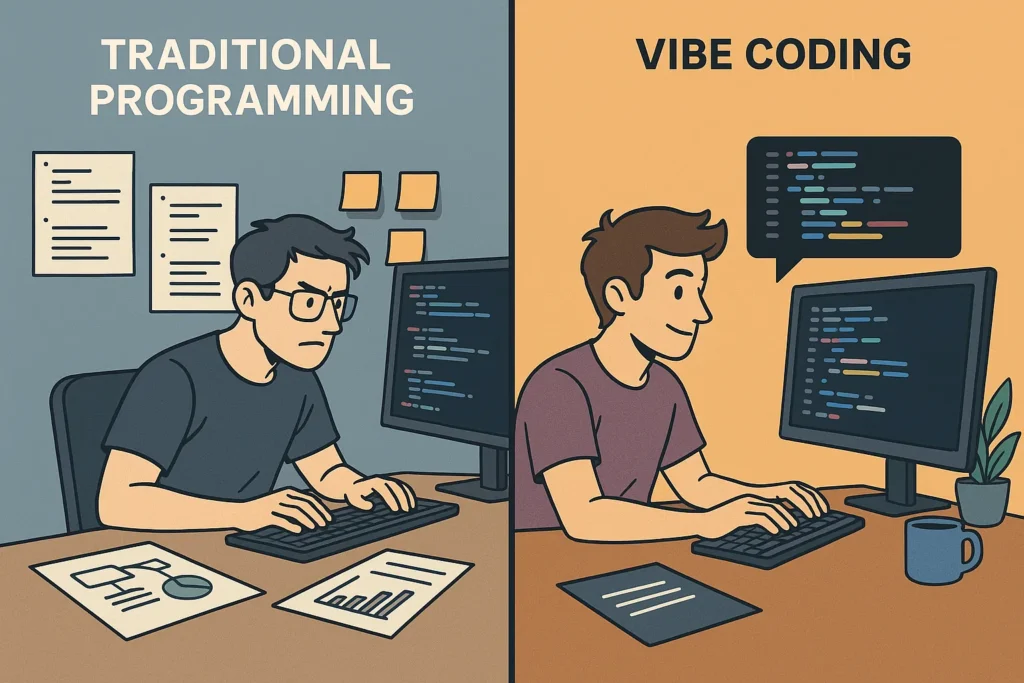
Vibe coding is not a programming language or a framework. It’s a mindset. Instead of writing every line of code manually, developers focus on explaining what they want and why they want it, while tools help generate, refine, and optimize the code.
Think of it like this. Earlier, developers spoke directly to computers using strict grammar. Now, developers speak in human intent, and machines translate that intent into working software. You still need to understand what’s happening under the hood, but you no longer need to fight with boilerplate or repetitive patterns.
In real projects, this already looks like developers describing a feature, reviewing AI-generated code, adjusting logic, adding safeguards, and testing edge cases. The “vibe” is about flow; staying focused on problem-solving instead of mechanical typing.
The reason everyone is talking about vibe coding is simple: it boosts productivity and lowers entry barriers, while increasing the importance of thinking skills.
2. How Software Development Looks Different in 2026
By 2026, software development is less about speed typing and more about decision-making. Codebases are larger, systems are more connected, and expectations are higher. AI tools are embedded directly into editors, version control, testing pipelines, and deployment workflows.
A developer’s day now includes reviewing suggestions, validating logic, correcting assumptions, and ensuring code aligns with business goals. Writing code is still there, but it’s no longer the bottleneck. Understanding the problem deeply is.
For example, building an API no longer starts with writing routes and handlers line by line. It starts with defining constraints, security rules, performance expectations, and data flow. The tooling helps generate a starting point, but the developer is responsible for correctness, safety, and long-term maintainability.
This means developers who only memorized syntax feel lost, while those who understand systems feel more powerful than ever.
3. What Skills Actually Matter in the Vibe Coding Era
The most valuable skill in 2026 is thinking clearly. If you can break a problem into steps, explain trade-offs, and anticipate edge cases, you can work with any tool.
Strong fundamentals matter more, not less. Data structures, basic algorithms, networking concepts, databases, and operating system behavior help you judge whether generated code is good or dangerous. Without fundamentals, vibe coding becomes blind trust; and that’s risky.
Another critical skill is communication. You must explain intent clearly to tools and to humans. Writing good prompts, documenting decisions, and reviewing code thoughtfully are now core developer tasks.
Finally, adaptability matters. Tools will change. Workflows will evolve. Developers who learn how to learn stay relevant longer than those who chase every new framework.
4. How to Prepare Yourself to Stay Relevant in the Software Industry
Start by strengthening your basics. If you’re a student or beginner, focus on understanding how things work, not just how to make them run. Learn one language deeply instead of five superficially. Understand why a solution works, not just that it works.
Practice building small but real projects. A simple expense tracker, a note-taking app, or an API for a mock service teaches more than endless tutorials. Use AI tools while building, but always ask yourself why a certain approach was chosen.
Develop the habit of reading code written by others. Reviewing good and bad code trains your judgment. This is exactly the skill vibe coding relies on; deciding what to keep, what to change, and what to reject.
Lastly, don’t panic about job loss. The industry is not removing developers; it’s filtering for clarity, responsibility, and problem-solving ability. Prepare for that, and you stay relevant.
5. Common Myths About AI, Vibe Coding, and Developer Jobs
One common myth is that AI will replace developers completely. In reality, it replaces repetitive tasks, not accountability. Someone still owns the system when it breaks.
Another myth is that beginners are doomed. In fact, beginners who learn fundamentals with modern tools often progress faster than those trained only in old workflows.
There’s also a belief that coding skills no longer matter. This is false. Coding matters, but blind coding doesn’t. Understanding and judgment matter more.
Summary
Vibe coding in 2026 is about intent-driven development, not typing speed.
The future belongs to developers who understand systems, think clearly, and adapt continuously.
Prepare by mastering fundamentals, building real projects, and learning how to work with intelligent tools instead of competing against them.
FAQ
Is vibe coding suitable for beginners?
Yes, if beginners focus on learning fundamentals alongside tools. Vibe coding helps beginners build faster, but understanding logic and basics is still essential to avoid bad habits.
Do I still need to learn programming languages deeply?
Absolutely. Deep knowledge helps you evaluate and fix generated code. Without it, you won’t know when something is wrong or unsafe.
Will traditional coding disappear by 2026?
No. Traditional coding still exists, but it’s no longer the main bottleneck. Decision-making, architecture, and validation matter more.
What should students focus on today to stay relevant?
Students should focus on problem-solving, fundamentals, and real projects. Tools will change, but clear thinking and strong basics will always be valuable.
Thanks for your time! Support us by sharing this article and exploring more AI videos on our YouTube channel – Simplify AI
Leave a Reply