
Generative AI is one of the most transformative technologies of our time, and learning it no longer requires a PhD or years of experience. From ChatGPT writing essays to DALL-E painting images from a sentence, these tools are reshaping how every industry works. Whether you are an engineering student, a developer, or simply someone curious about what all the noise is about, this roadmap gives you a clear and honest path to understanding and building with Generative AI. By the end of this article you will know exactly what to learn, in what order, and why it matters.
Table of Contents
- From Basics to Breakthroughs: The Foundation of GenAI
- The Core Mechanics: LLMs, Images, Prompts, and Multimodal AI
- Applied GenAI: Fine-Tuning, Agents, and Building Real Applications
- Responsibility and the Road Ahead: Ethics, Safety, and Careers
From Basics to Breakthroughs: The Foundation of GenAI
Before you can build with Generative AI, you need to understand what it actually is and how it differs from the broader world of artificial intelligence. AI is the umbrella term for any machine that can perform tasks requiring human-like intelligence. Machine learning is a subset of AI where models learn patterns from data instead of following fixed rules. Deep learning goes further by using layered neural networks to find complex patterns in large datasets. Generative AI sits at the frontier of all three, using these deep networks to create entirely new content such as text, images, audio, and code.
The history of this field matters because it explains why Generative AI feels like a sudden leap. For decades, AI systems were narrow and rule-based, capable of recognising a face or filtering spam but nothing more. The introduction of neural networks changed the game by allowing machines to learn representations of data rather than follow hand-written rules. The invention of the transformer architecture in 2017, described in the famous paper “Attention Is All You Need”, was the single breakthrough that made modern Generative AI possible. Everything from GPT-4 to Gemini to Claude is built on this foundation.
Neural networks are the engine underneath every generative model. Think of them as layers of simple mathematical functions, each layer learning to recognise slightly more abstract features than the one before it. Input goes in at one end, passes through dozens or hundreds of layers, and a prediction or generation comes out the other end. The network learns by comparing its output to the correct answer and adjusting itself slightly through a process called backpropagation, repeated millions of times across a large dataset.
The transformer architecture took this further by introducing a mechanism called self-attention, which allows the model to weigh how relevant every word in a sentence is to every other word simultaneously. This was a massive improvement over older models that read text one word at a time and struggled to connect ideas separated by many sentences. Self-attention is why a large language model can write a coherent 2000-word article or answer a question that requires connecting multiple pieces of information from different parts of a document.
The Core Mechanics: LLMs, Images, Prompts, and Multimodal AI
Large Language Models are the most visible face of Generative AI today. They work by predicting the most likely next token, which is roughly a word or word fragment, given everything that came before it. During training on enormous text datasets, the model builds a compressed statistical map of human language, knowledge, and reasoning patterns. At inference time, when you type a question, the model uses this map to generate a response one token at a time. This is why models like GPT-4, Claude, and Gemini can answer questions, write code, summarise documents, and hold surprisingly coherent conversations.
Image generation works on a completely different principle. The most popular approach today is diffusion, where the model learns to take a completely noisy image and gradually remove the noise until a clear, coherent picture emerges. The direction of that denoising process is guided by a text prompt, which is how typing “a sunset over the mountains in oil painting style” produces exactly that. Tools like Stable Diffusion, DALL-E, and Midjourney all use variations of this approach. An older architecture called GANs, or Generative Adversarial Networks, used a different method where a generator and discriminator competed against each other to produce realistic images. Diffusion models have largely surpassed GANs for image quality, but understanding both gives you a fuller picture of the field.
Prompt engineering is the skill of communicating with AI models effectively to get the outputs you actually want. It is a deceptively important skill because the same model can produce mediocre or outstanding results depending entirely on how the question is framed. Zero-shot prompting means giving the model a task with no examples. Few-shot prompting means including two or three examples in the prompt to guide the model’s response style. Chain-of-thought prompting instructs the model to reason step by step before answering, which dramatically improves accuracy on complex questions. Mastering these techniques multiplies the practical value you get from any AI tool.
Multimodal AI represents the direction the entire field is moving. Models like GPT-4o and Gemini 1.5 Pro can accept text, images, audio, and video as input and generate responses that combine multiple modalities in return. You can show a model a photograph and ask it to describe what is happening, or speak a question out loud and receive a spoken answer back. This convergence is important because real-world problems rarely come in a single clean format. A medical AI needs to read a doctor’s notes, look at a scan, and cross-reference symptoms simultaneously. Multimodal models make this kind of reasoning possible.
Applied GenAI: Fine-Tuning, Agents, and Building Real Applications
Knowing how Generative AI works is one thing. Knowing how to make it work for a specific purpose is where real value is created. Fine-tuning is the process of taking a general-purpose pretrained model and training it further on a smaller, domain-specific dataset so it becomes an expert in a particular area. A base LLM trained on the entire internet is a generalist. Fine-tuned on thousands of legal contracts, it becomes a legal assistant. Fine-tuned on medical literature, it becomes a clinical reasoning tool. This is how companies build specialised AI products without training a model from scratch, which would cost millions of dollars.
Retrieval-Augmented Generation, commonly called RAG, solves a different problem. LLMs are trained on data up to a certain date and cannot access private company documents or real-time information. RAG gives the model a memory by connecting it to an external knowledge store. When a user asks a question, the system first retrieves the most relevant documents from a vector database using semantic search, then passes those documents into the model’s context alongside the question. The model answers based on the retrieved content rather than its training data alone. This is the architecture behind most enterprise AI assistants built today.
AI agents take Generative AI beyond question and answer into autonomous action. An agent is an AI system that can receive a goal, break it into steps, use tools like web search, code execution, and API calls to take real-world actions, and keep working until the task is done. The underlying model reasons about what to do next at each step, observes the result, and adjusts its plan accordingly. This is how AI systems can book a meeting, write and run a data analysis script, or research a topic and compile a report without any human intervention at each step. Understanding agents is essential because they represent the practical deployment model for AI in the near future.
Building with GenAI APIs is where all the theory comes together in practice. The OpenAI, Gemini, and Anthropic APIs give you direct programmatic access to the most powerful models in the world through a simple HTTP call. With a few dozen lines of Python, you can build a customer support chatbot, a document summariser, a coding assistant, or a creative writing tool. No-code platforms like Flowise and Dify make this accessible even without programming knowledge. The key insight at this stage is that you do not need to understand every mathematical detail of how transformers work to build genuinely useful applications on top of them.
Responsibility and the Road Ahead: Ethics, Safety, and Careers
Building with powerful AI systems comes with serious responsibilities that cannot be treated as an afterthought. Hallucination is one of the most important limitations to understand. A language model generates the statistically most likely next token, which means it can produce confident-sounding text that is factually wrong. It does not know what it does not know. A model answering a question about a medical procedure or a legal requirement might generate a plausible-sounding but dangerous answer. Always verify critical outputs and never deploy AI in high-stakes domains without human oversight and validation systems in place.
Bias in AI systems is a real and well-documented problem. Because models learn from human-generated data, they absorb human prejudices, stereotypes, and historical inequities present in that data. A hiring AI trained on decades of resumes from a male-dominated field will systematically favour male candidates. A facial recognition system trained primarily on lighter-skinned faces will perform worse on darker-skinned faces. Recognising that bias enters through training data, label choices, and model design is the first step toward building systems that are fair and accountable.
The misuse of Generative AI, particularly through deepfakes and synthetic media, is a growing societal challenge. Realistic fake images, audio, and video can be created in minutes and spread faster than corrections can follow. Understanding both the technical mechanism and the social consequences of this capability is part of being a responsible AI practitioner. On the legal side, questions around copyright, data ownership, and model outputs are still being resolved by courts and regulators worldwide.
Career opportunities in Generative AI are expanding rapidly across every industry. Prompt engineers help organisations get the best results from AI tools. AI engineers build and deploy pipelines using LLMs and vector databases. ML engineers work on model training, fine-tuning, and evaluation. AI product managers define what should be built and who it serves. Researchers push the frontier of what models can do. The most important thing to understand is that this is a field where practical ability matters as much as formal credentials. Building real projects, sharing them publicly, and staying current with a fast-moving literature are the three habits that distinguish people who thrive in AI from those who simply talk about it.
Key Takeaways
- Generative AI sits at the intersection of AI, machine learning, deep learning, and the transformer architecture which made it all possible.
- Large Language Models predict the next token using patterns learned from vast text datasets and are the foundation of tools like ChatGPT, Claude, and Gemini.
- Image generation uses diffusion models that learn to remove noise from images guided by text prompts, powering tools like DALL-E, Midjourney, and Stable Diffusion.
- Prompt engineering is a high-leverage skill. Zero-shot, few-shot, and chain-of-thought techniques dramatically change the quality of AI outputs.
- Fine-tuning adapts a general model to a specific domain while RAG gives models access to private and real-time knowledge through vector databases.
- AI agents combine reasoning, tool use, and autonomous action to complete multi-step tasks without human intervention at each step.
- Hallucination, bias, and misuse are real limitations that every practitioner must understand and actively manage in production systems.
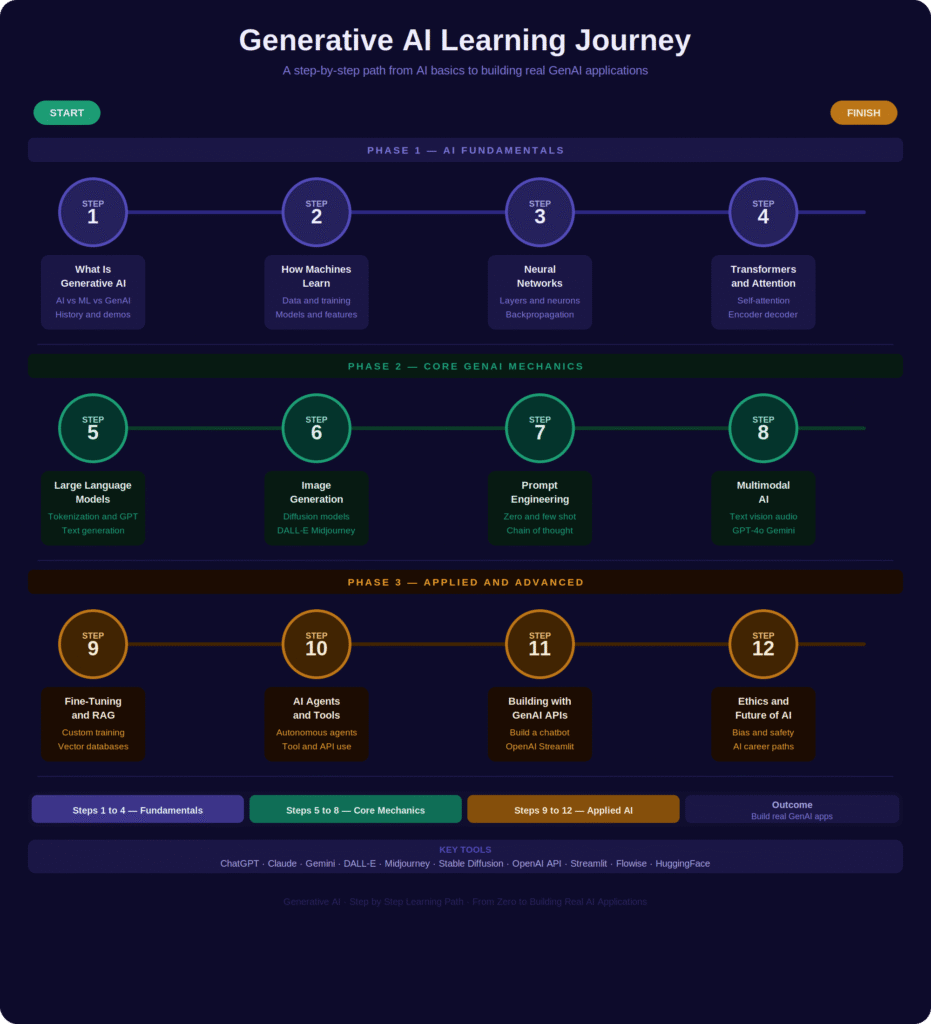
- The 12-step roadmap from fundamentals to applied AI is designed so any beginner can follow it without prior experience in machine learning.
FAQ
What is the difference between AI, machine learning, and Generative AI?
AI is the broad concept of machines performing intelligent tasks. Machine learning is a subset where machines learn from data instead of following fixed rules. Generative AI is a specific type of machine learning where the model creates new content such as text, images, or audio rather than just classifying or predicting from existing data.
Do I need to know maths or coding to learn Generative AI?
You do not need advanced maths to get started with using and building on top of Generative AI tools. Basic Python is enough to call APIs and build simple applications. A deeper understanding of linear algebra and calculus becomes useful if you want to fine-tune models or do research, but the vast majority of practical applications can be built with no mathematical background beyond general programming skills.
What is the best way to start learning Generative AI as a complete beginner?
Start by using the tools directly before studying the theory. Spend time with ChatGPT, Claude, and DALL-E to build intuition about what these systems can and cannot do. Then follow a structured roadmap that moves from AI basics through neural networks, transformers, and LLMs before reaching applied topics like prompt engineering, RAG, and agents. Hands-on projects at every stage matter more than passive reading.
How is Generative AI different from traditional AI or automation?
Traditional AI and rule-based automation follow rigid pre-programmed instructions and break when they encounter situations outside their rules. Generative AI learns flexible representations of language, images, and knowledge from data and can handle ambiguous, open-ended inputs in a way that scripted systems simply cannot. This makes Generative AI far more versatile and capable of tasks that would require enormous manual effort to program explicitly.
Thanks for your time! Support us by sharing this article and exploring more AI videos on our YouTube channel – Simplify AI
Leave a Reply